
April 5, 2026
About the Author: Kavi

The age-old question that every music aspirant, enthusiast or perhaps, a parent who has fulfilled the duty of parenthood, with a little more time on their hands, is the elusive pursuit of the art of music.
Music is the language within which souls gravitate towards.
From the time a person is born into this world to the time of his death, music is and always will be interwoven into every fabric and fibre of his being, whether it is in the soulful tune and longing of a baby’s cry for their mother, to the memories of a birthday celebration with the all too famous “Happy Birthday” tune, from the silent rustling of the trees that produces a sense of calm to the roaring of the waterfall, producing in itself, a sense of awe and reverence in the thunderous symphony of nature, music is ever present and stirs a curiosity within for this mysterious force.

Music Through History and Access to Learning
Music, and the pedagogy of it, has never always been a mainstream idea.
Even in the 16th century at the time of famous composers such as Johann Sebastian Bach, Joseph Haydn and noteworthy personalities, music was more for the nobility and middle-class folk.
These were characters of renown, pioneers who paved the way for modern music and setting up foundations for the generations to come.
Moreover, with the invention of the printing press by Gutenberg around the year 1440, distribution of musical notation and books on musical methods became a major factor in levelling the playing field for not just aristocracy but the common man to involve themselves in this exquisite art.

How Modern Developments Changed Music Education
As the centuries progressed and with the coming of major milestones for human civilization as a whole such as the Industrial revolution which revolutionized daily living with inventions such as the light bulb in the late 19th century, or the digital revolution, modernized communication systems and perhaps the most significant advancement known to mankind – the internet, learning and avenues of learning became more and more accessible, information became available at the click of a button, and with all this, picking up an instrument and learning how to play it without formal training suddenly became a viable option.
The information age brought about a paradigm shift in terms of how information became available with reduced costs and without a need for physical movement.
Learning music suddenly was no longer a far-off dream for those who could not do so because of the many constraints they could have been subjected to in the past.

The Fear Behind Starting Music Later in Life
Often, when the question of pursuing music is asked, especially for someone who doesn’t necessarily fit the bill, someone who, in general, is written off, perhaps because of their background, their age or even their upbringing; the framework of the thought behind it is the silent fear of inadequacy that resonates deep within, the possibility of never fulfilling a dream long forgotten.

Psychological Concerns and Perceived Limitations
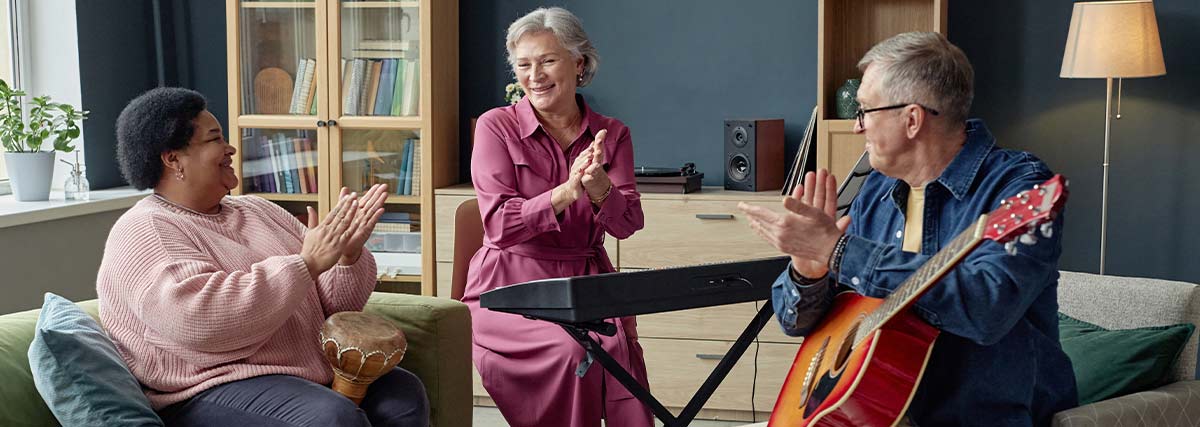
From a psychological standpoint, factors such as motor control, memory retention and mind-numbing degenerative diseases seem to be the leading causes of the supposed inability of learning music.
For people in the senior citizen category, many seemed to have completely succumbed to the resolve that their mental faculties and physical abilities are stunted or severely diminished because of their advanced age or even because of mental illnesses such as dementia, Parkinson’s and so on.
Music Therapy and Inspiring Examples From Musicians
However, those of whom have dabbled in the aspects of music therapy, in using music as a therapeutic method of treating patients suffering from various mental ailments have had positive rather than negative results from the exercise.
In fact, there are a myriad of musicians and musical artists who suffer from some form of mental illnesses and yet are performing at the top level in their field of work.
One of the most famous artists of this modern century, Billie Eilish, revealed in an interview on Netflix’s “My Next Guest Needs No Introduction with David Letterman”, about her ongoing struggle with Tourette’s, and how her tics such as jaw clicks and so on, stop when she performs and is in a deep creative flow.
Even musicians who are considered pioneers in the music field such as Ludwig Van Beethoven who composed the famous “Symphony No. 5 in C minor” with its iconic -4 note motif (ba-ba-ba-bam), suffered from a bi polar disorder and was physically deaf in the final decade of his life, so much so that when the audience’s applause thundered the room and was even given a standing ovation, Beethoven didn’t even realize it and went on with his back turned to the audience and continued conducting the orchestra.
Bill Withers, who was a three-time Grammy award winner, gifting the world with inspirational and soul-searching compositions such as “Ain’t No Sunshine” and “Lean On Me”, wasn’t truly a musician by birth nor in his childhood.
He lived in a time when segregation and marginalisation were commonplace.
During his childhood, he suffered from a stutter which got better over time as he enlisted in the army and started serving there.
When he left the Navy afterwards, he finally pursued his dream of making it in the music industry, having learned a few guitar techniques while at work at an aircraft factory.
His triumph and success only came in his 30s, despite beginning his music career late into his life.
Persistence, Passion and Breaking Perceived Barriers
There are hundreds and hundreds more examples of tales of exemplary persistence, dedication and sheer willpower to attain the impossible even when it did not look like an option.
However, what separated these people from mere wishful thinking was the drive and passion with which they approached their art.
It is safe to say that the limitations that the ordinary individual would deem acceptable were shattered through and through by a class of individuals who dared to dream beyond their immediate capabilities and pushed their limits.
Believing in Your Musical Dream
To the individual today, who deep in their hearts long to see the day that their long-lost dream of pursuing music can come to fruition, is there any mountain too high, any peak too steep to climb?
There are those who have gone the way and conquered that elusive victory, dedicated themselves to the art, through blood, sweat and tears to pave the way for those who have a silent dream within.
As Martin Luther King’s famous, “I Have a Dream” speech which brought about a revolution and a lasting legacy; For the reader today, you may have a longing, but what is required of you is to believe and go the distance, nothing is impossible.
For adults in Dubai who feel inspired to begin their musical journey later in life, the S&C Music Center at Gate Avenue Mall in DIFC offers structured one-to-one music lessons designed specifically for adult learners at every level, from complete beginners to advanced amateur musicians.

RELATED POSTS