
February 20, 2026
About the Author: Stefan Joubert

In recent years, artificial intelligence has quietly entered the practice room.
From smart pianos that track accuracy to apps that analyse rhythm in real time, technology is reshaping how students engage with the instrument.
For many learners, particularly busy professionals and digitally native students, AI tools offer immediate feedback, structure and measurable progress.
Yet with innovation comes an important question:
Can artificial intelligence genuinely improve piano practice, or does it risk replacing the depth of traditional teaching?
The answer lies not in choosing one over the other, but in understanding how they work together.

Real-Time Feedback: A New Layer of Awareness
One of the most powerful contributions of AI to piano learning is instant feedback.
Modern apps can detect wrong notes, uneven rhythm and tempo fluctuations within seconds.
Instead of waiting a week for correction, students receive immediate information about what needs attention.
For beginners, this can accelerate foundational accuracy, while intermediate players can sharpen rhythmic control.
The ability to visualise mistakes in real time strengthens listening awareness and accountability.
However, feedback is only useful if interpreted correctly.
AI can identify what was inaccurate, but it cannot always explain why, whether the issue stems from tension, misunderstanding of fingering, or lack of structural awareness in the music.
This is where traditional teaching remains indispensable.

Smart Instruments and Measurable Progress
Smart pianos now record practice time, track consistency and analyse performance data.
For students who thrive on structure, this can be motivating, as clear metrics transform vague intentions into visible progress.
Instead of saying, “I practised a little,” students can see how long they worked on a passage, how stable their tempo remained, and how accuracy improved over time.
For busy learners balancing work or school commitments, this measurable clarity supports disciplined habits.
Yet numbers alone do not create musicality.
A performance can be perfectly accurate and emotionally empty, as tone colour, phrasing, voicing and expressive shaping still require artistic guidance and critical listening beyond algorithmic analysis.
Personalised Learning Paths
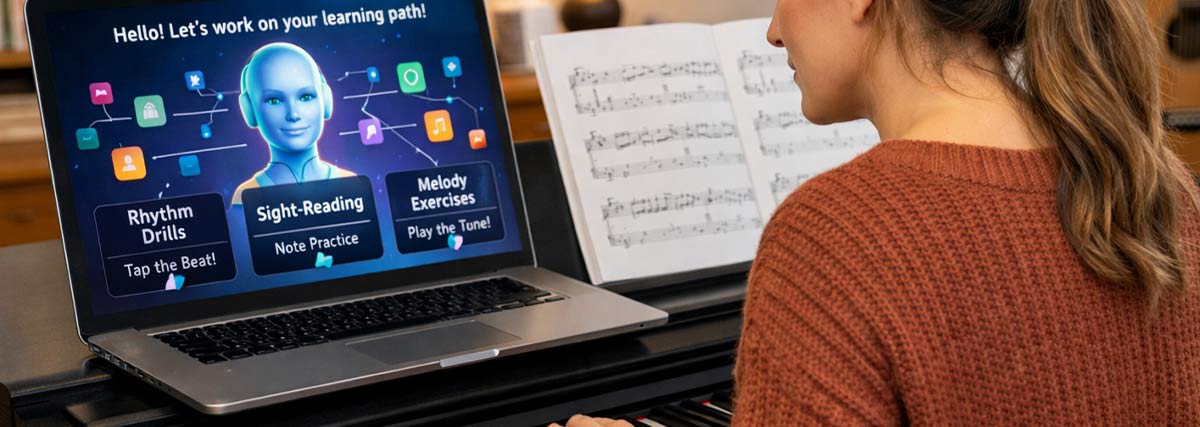
AI-powered platforms increasingly adapt exercises based on a student’s level and weaknesses.
If rhythm is unstable, the system may assign additional metrical drills, and if note-reading lags behind, sight-reading tasks are prioritised.
This level of personalisation mirrors what experienced teachers naturally do in lessons, while also providing reinforcement between sessions.
Used wisely, such tools can strengthen independence, encourage daily engagement and provide structured review.
Used excessively, however, they risk narrowing musical exploration into gamified tasks rather than expressive study.
Balance is essential.

The Human Element Cannot Be Replaced
Piano playing is not solely mechanical accuracy; it is physical coordination, emotional communication and artistic interpretation.
An experienced teacher observes subtle details that AI cannot yet detect reliably, such as tension in shoulders or wrists, inefficient arm movement, insecure hand positioning, and emotional hesitancy in phrasing.
Moreover, music education involves mentorship.
Confidence, resilience and long-term vision are cultivated through human interaction, where encouragement, correction and artistic discussion shape not only technique but mindset.
AI can support practise, but it cannot replace musical wisdom.

How Students Should Approach AI Tools
For students at S&C Music, the most effective approach is integration rather than substitution.
Artificial intelligence works best when it reinforces material introduced in lessons, provides additional rhythmic discipline, encourages structured daily practise, and highlights small inaccuracies early.
It should not replace careful listening, expressive exploration or professional instruction.
When used thoughtfully, technology becomes a training partner rather than a teacher.

A Modern Practise Room
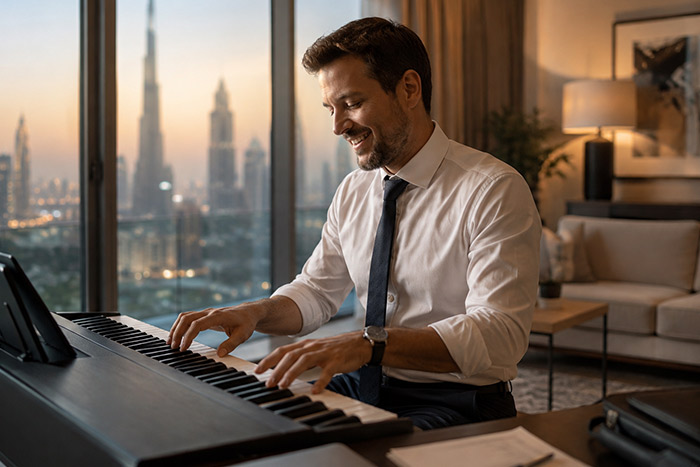
We are entering an era where the piano studio and digital environment coexist seamlessly.
Students can receive weekly expert guidance while benefiting from intelligent practise tools between sessions.
This combination offers something powerful: immediate feedback alongside artistic mentorship, measured progress alongside expressive growth, and efficiency alongside depth.
AI is transforming piano practise — not by replacing tradition, but by refining it.
The future of piano education is not purely digital, nor purely classical.
It is intelligently blended.
And for students willing to embrace both discipline and innovation, the possibilities are greater than ever.
Related Articles:
RELATED POSTS