
سبتمبر 13, 2026
عن المؤلف: S&C Music

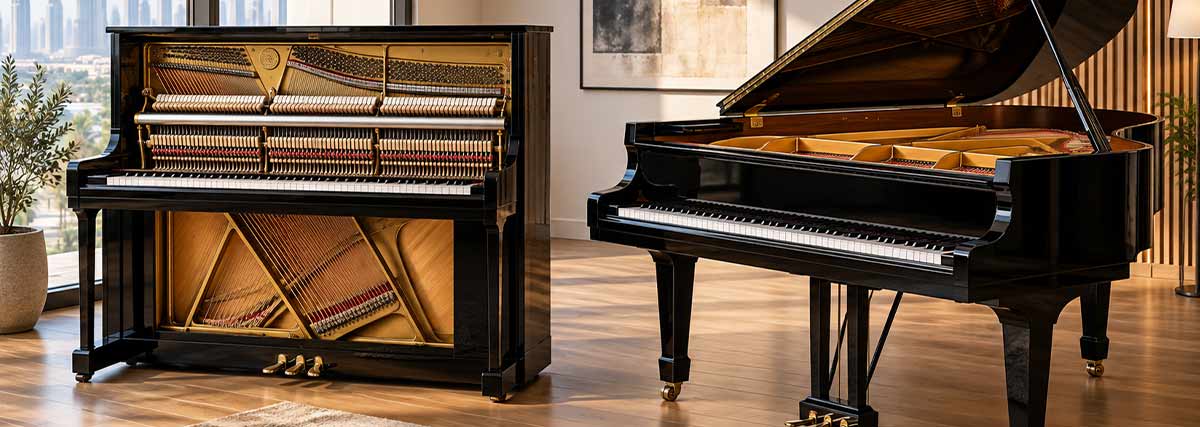
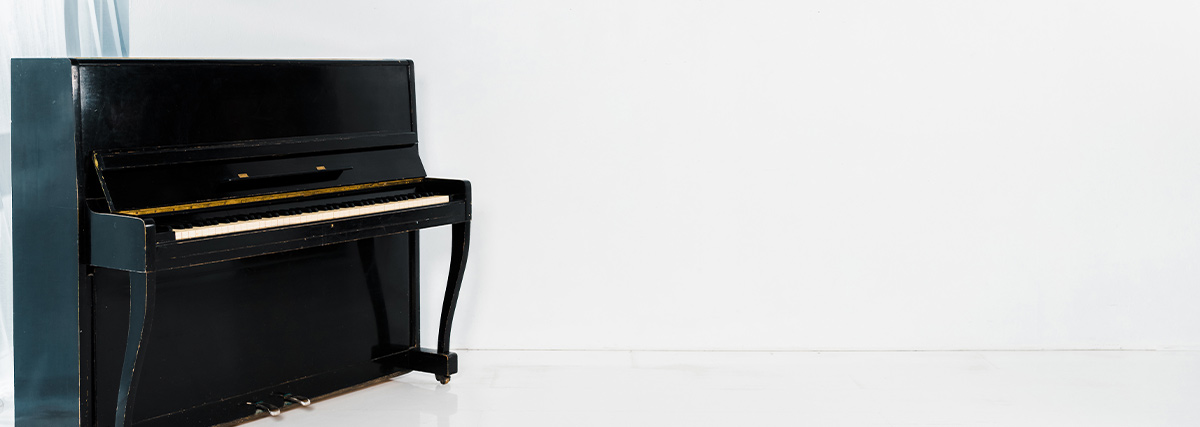
At first glance, the difference between an upright piano and a grand piano appears to be mainly one of shape. An upright stands vertically against a wall, while a grand extends horizontally into the room.
Beneath the casework, however, the two instruments differ in ways that can influence touch, repetition, tone, pedalling and the way a pianist approaches demanding music.
These are the upright vs grand piano technical differences every pianist should know before choosing an instrument.
A well-made and carefully maintained upright can be far more rewarding than a neglected baby grand.
Understanding these differences will help you assess each piano on its merits and select one that suits your level, repertoire and home.
The Fundamental Difference in Design
Both upright and grand pianos produce sound through the same basic process.
When a key is pressed, a felt-covered hammer strikes one or more strings.
Their vibrations travel through the bridges to the soundboard, which amplifies and projects the sound.
The main distinction is the orientation of these components.
In a grand piano, the strings, soundboard and action are arranged horizontally.
The hammers travel upwards to strike the strings and return largely through gravity.
In an upright piano, the strings and soundboard stand vertically.
Its hammers move forwards and depend more heavily on springs and other components to return to their resting position.
This difference in layout affects both the response of the keyboard and the way the sound travels through the room.

Piano Action, Touch and Repetition
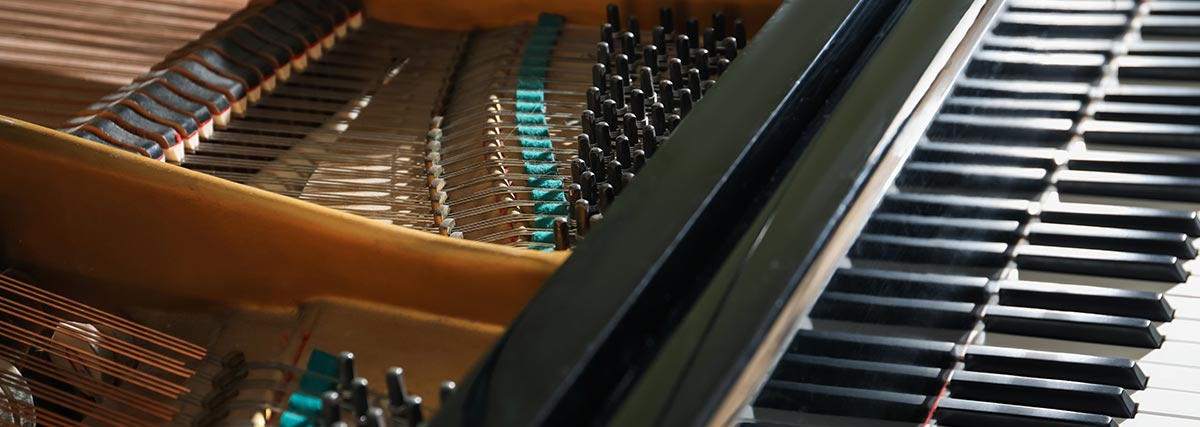
The action is the intricate system of levers connecting each key to its hammer.
Its design has a direct effect on how the instrument responds beneath the fingers.
A grand piano action generally feels more immediate and finely controlled.
As gravity helps the hammer return, the mechanism resets naturally and efficiently.
This makes it easier to produce subtle differences in articulation and dynamics.
Modern grand pianos also use a repetition mechanism commonly known as double escapement.
It enables a note to be played again before the key has returned fully to its original position.
Rapid repeated notes, trills and repeated chords can therefore be executed with greater speed and reliability.
On a traditional upright action, the key must usually return farther before the note can be repeated.
A high-quality upright can still feel precise and responsive, but the difference becomes more noticeable in advanced music requiring very fast repetition or exceptional control at quiet dynamics.
For a beginner or recreational pianist, either action can provide an excellent foundation.
What matters most is that it is properly regulated, with keys that respond evenly and consistently.
String Length, Soundboard and Tone
Grand pianos generally have room for longer strings, particularly in the bass.
Longer bass strings tend to produce a clearer fundamental pitch, greater depth and a more sustained tone.
An upright must fit its strings into a taller but much narrower case.
Manufacturers use wound bass strings and an overstrung design to make effective use of the available space.
Taller uprights can accommodate longer strings than compact models and may produce an impressively rich bass.
Size also matters among grand pianos.
A small baby grand does not automatically possess a better bass register than a tall, well-constructed upright.
The quality of the materials, soundboard, scaling and workmanship all influence the result.
The position of the soundboard affects projection too.
A grand piano’s horizontal soundboard projects upwards and downwards.
When its lid is raised, the sound can travel broadly through the room, producing the resonance and carrying power associated with recital and concert settings.
An upright projects much of its sound from the back, often towards a nearby wall.
Its position, the floor surface and the furnishings in the room can significantly affect the tone.
Moving an upright slightly away from a hard wall may improve clarity and prevent the sound from becoming overly bright or congested.

Dynamic Range and Musical Control
A fine grand piano usually offers a wider dynamic range, from a delicate pianissimo to a powerful fortissimo.
Its responsive action, longer keys and larger resonating body allow an experienced pianist to shape volume and tone with considerable precision.
This is particularly valuable when balancing several musical layers at once.
A pianist may need to project a melody while keeping the accompaniment soft and allowing an inner voice to remain audible.
A grand action can make these distinctions easier to control.
High-quality upright pianos are also capable of expressive and nuanced playing.
For lessons, home practice and much of the standard repertoire, a good upright offers ample tonal variety.
The condition of the hammers, action and strings, as well as the quality of the instrument’s regulation and voicing, often matter more than the category alone.
The length of the keys contributes to the difference in touch.
Grand pianos generally have longer keys, giving the player better leverage, especially when playing close to the fallboard.
This can be helpful in passages involving black keys, wide chords or hand positions deep within the keyboard.
How the Pedals Differ
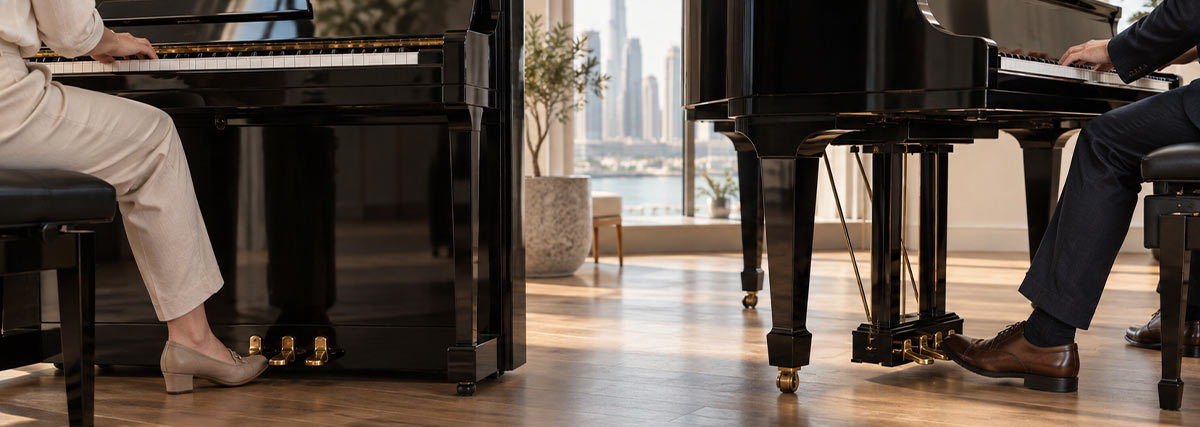
The right pedal is the damper, or sustaining, pedal on both upright and grand pianos.
It lifts the dampers from the strings so that notes continue to resonate after the keys have been released.
The left pedal works differently.
On a grand piano, the una corda pedal shifts the keyboard and action slightly sideways.
The hammers then strike fewer strings in much of the register, or touch a different area of the felt.
This changes the tone colour as well as reducing the volume.
On most upright pianos, the left pedal moves the hammers closer to the strings.
The shorter striking distance produces a softer sound, but usually without the same degree of tonal change.
The middle pedal varies as well.
On most grand pianos, it is a sostenuto pedal, sustaining only the notes held when the pedal is depressed.
On many uprights, the middle pedal lowers a strip of felt between the hammers and strings for quieter practice.
On other models, it may sustain only the bass notes.
It is therefore worth checking the pedal functions of the individual instrument.
Space, Climate and Everyday Ownership
An upright piano has a relatively small footprint and can sit neatly against a wall, making it a practical choice for flats and family homes.
A grand requires considerably more floor space, including room for the bench and safe movement around the instrument.
The acoustic size of the room matters too.
A powerful grand may overwhelm a small, reflective space, whereas an upright can provide a more balanced listening experience.
Greater volume is not automatically better; the instrument should complement its surroundings.
In Dubai, both types require careful environmental management.
Acoustic pianos contain wood, felt and other materials that react to changes in temperature and humidity.
An instrument should be kept away from direct sunlight, strong air-conditioning draughts and sudden climatic changes.
Regular tuning and periodic technical servicing are essential.
Delivery should also be considered before purchase.
A grand piano requires sufficient access through doors, corridors, lifts or staircases and must be handled by specialist movers.
An upright is easier to accommodate, although its substantial weight still demands professional transport.

Which Piano Is Better for Practice?
For many adult pianists, a high-quality upright is the most sensible acoustic piano for daily practice.
It provides a full-sized keyboard, a genuine mechanical action and a natural acoustic response without taking over the room.
A grand piano becomes especially valuable for pianists who need faster repetition, a wider dynamic range, more refined pedalling and greater control over advanced repertoire.
It is also better suited to performance spaces where projection and tonal breadth are important.
Specifications alone, however, cannot reveal how enjoyable an instrument will be to play.
Before choosing, test slow scales at a soft dynamic, repeat individual notes at different speeds and play chords close to the backs of the keys.
Listen for clarity in the bass, evenness through the middle register and excessive brightness in the treble.
Try the pedals carefully and notice whether the action feels consistent across the keyboard.
When considering a used piano, arrange an independent inspection by a qualified piano technician.
Attractive casework can conceal worn action parts, poor tuning stability or expensive structural problems.

Upright vs Grand Piano: Making the Right Choice
The most important differences between an upright and a grand piano are mechanical and acoustic rather than merely visual.
A grand piano’s horizontal, gravity-assisted action provides faster repetition and refined control, while its larger resonating structure can offer greater tonal breadth and projection.
An upright provides an authentic acoustic playing experience within a far more efficient footprint.
The right choice depends on the quality and condition of the individual piano, the room in which it will be placed, the music you enjoy and your long-term ambitions.
A fine upright is often preferable to a mediocre baby grand, while an accomplished pianist may find that a well-maintained grand offers expressive possibilities that become increasingly valuable over time.
At S&C Piano in Dubai, دروس البيانو لدينا help adult learners develop the technique and listening skills needed to understand these differences at the keyboard.
Whether you practise on an upright or a grand piano, expert guidance can help you play with greater control, confidence and expression.

مقالات ذات صلة